2025年6月14日土曜日

散歩など Walk etc

 今日は、朝のうちはまだ雨が降っていなかったので、少し蒸し暑いながらも散歩を楽しめました。

We managed to enjoy our morning walk before it started to rain again.  Although humid, it was pleasant to be in the park.


サルナシ棚やベンチの後ろ側には数本の「アルプス乙女」が植わっています。

Behind the baby kiwi scaffolding and benches, there are several crab apple trees.

それらのうち、この木には幼果がたくさん着いています。葉っぱが極端に少ないのに幼果がこんなに着いているのは不健康。枯れる前兆かもと思ってしまいます。これまでここのリンゴの木が何本も枯れるのを見てきました。土は公園のカツカツの土、水やりなし。さらに、公園の方針で、樹木には施肥、消毒、普通の意味での剪定などはしないことになっています。台風などで大枝が折れたりすれば、かた付け目的の剪定はするけど、それ以上の世話はしないことになっています。
One of them has a lot of young fruits on it.  Moreover, the tree has alarmingly few leaves and, on the whole, it looks unhealthy.  Perhaps this is a sign that this tree will die within a few years.  In this corner, I have seen several apple trees dying over the years.  The soil is hard and dry.  I am told that it is the policy of the Johoku Park management not to interfere with any of the trees in the park, including fruit bearing trees.  So, no fertiliser, disinfectant, or normal pruning.  If a branch breaks off in a typhoon, they will come to tidy it up, but that is all.

この草地には2本のザクロの木もあります。現状を見に行こうとしたら、
There are two pomegranate trees in this field.  I wanted to go and check how they were but

タイガがスリゴロを始めてしまいました。
Taiga started rolling on the grass.


すっきりした?  
Happy?

これは手前の木。
This is the first tree.

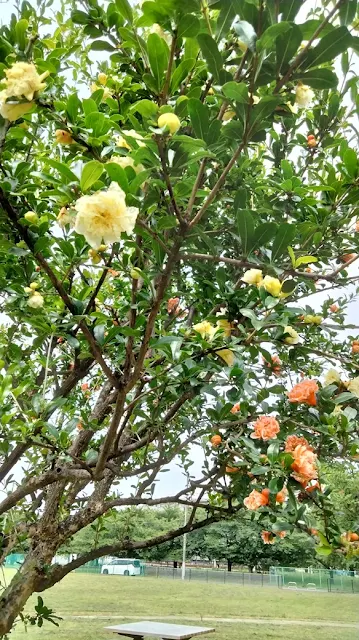
覆輪入りのハナザクロで「錦抱榴(きんぽうりゅう)」という品種のようです。
These are orange flowers with cream rims - a cultivar called 'Kinpouryu'.

咲き分けが起こっていて、枝のうちにはクリーム色の花が咲くものがあります。去年の秋に、完熟の実がパッカンと開いている頃に通りかかったら、一部の実が白かったのでびっくりしましたが、たぶんこの枝の実だったのでしょう。
This cultivar often has branches with cream flowers.  When the fruits were ripe in autumn last year, I saw some of them with white flesh inside.  They must have been from these branches.  I went home and searched online and learned about this cultivar.


もう1本のザクロの木は、花のオレンジ色が濃くて、覆輪も控えめです。個人的にはこちらのほうが綺麗だと思います。また、この木には咲き分けが起こっていないようです。
The other tree also has orange flowers with cream rims, but the rims are much narrower.  With the deeper orange colour, I prefer this version.  Also, this tree has no bud mutation with cream flowers.

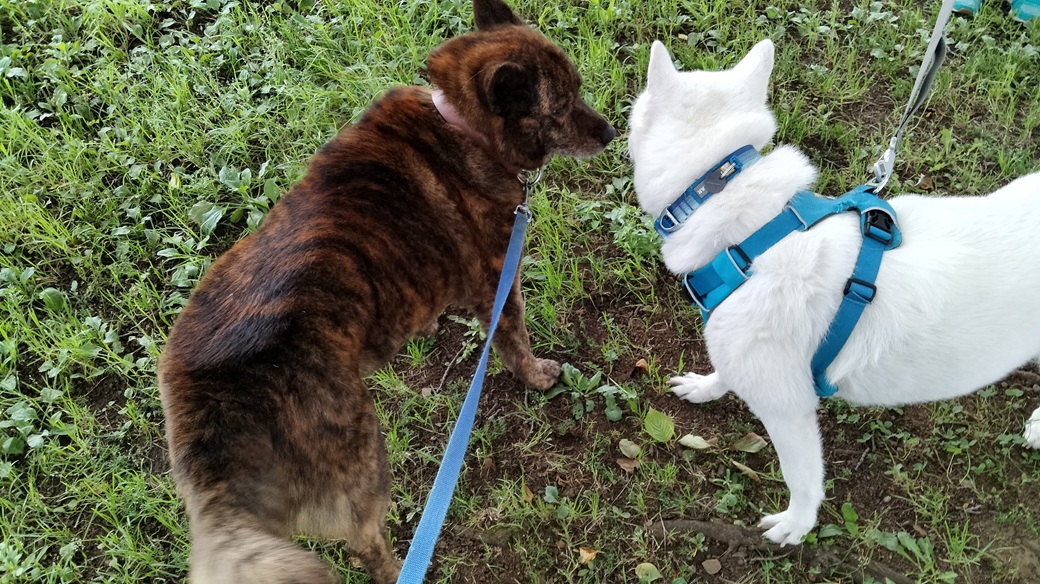
そろそろ帰ろうとした頃に、近所の紀州犬のウメちゃんがやって来ました。ウメちゃんはデリケートな体質で、この蒸し暑い気候は相当キツイようです。
We were about to head home when we ran into Ume, our neighbour's Kishuken.  Her constitution is delicate, and this humid climate is not helping her.

乾燥・低温の冬の間は皮膚が回復して毛が綺麗に生えそろっていたのに、梅雨の気候でお尻と尻尾の一部の毛がまた抜けてしまいました。しんどそうな様子なのでゆっくり歩いてもらうために、タイガと私はそのまま帰ることにしました。
During the dry and cold winter, her skin had recovered fully, and her coat was beautiful.  Now in the rainy season, parts of her buttock and tail are losing hair.  She looked struggling, so we left her in peace and came home.

================================

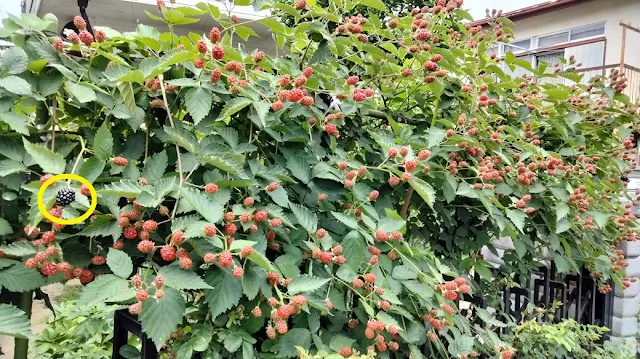
昨日からブラックベリーのナバホが熟し始めました。昨日のは早速野鳥にもっていかれたので、朝散歩から帰って今日の様子を確認。1個が食べかけの状態。途中で放り出すほど美味しくなかったのなら、これに懲りてもう来ないで。
My Navaho blackberries have started to ripen.  A few of them were ready yesterday but wild birds got ahead of me.  So, coming home from walk this morning, I checked to see how they looked.  This berry was half eaten.  If the bird did not find the berry to its taste, please do not come back.

他には2個、熟していそうなのがありました。
I saw two more seemingly ready to be picked.


無傷で今年の初物をゲット。食べてみると、若干早めでも十分美味しかったです。
The first blackberries of the year.  Although they were still shiny, they actually tasted delicious. 

2025年6月13日金曜日

散歩など Walk etc

 早朝散歩で家を出てすぐ、前方にペキニーズのユキヤが伏せして待っているのが見えました。ユキヤは近所に住んでいますが、いつもは時間帯が合わないのでめったに会えません。ユキヤは数えきれないほどの洋服を持っていて、会うたびに見たことない服を着ていますが、さすがにこの蒸し暑い気候では何も着ないようです。

Shortly after leaving home, we saw in the distance a male Pekinese, named Yukiya, crouched on the ground, waiting for us to approach.  Yukiya lives nearby but, due to different hours we walk, we rarely meet with each other.  He has countless clothes in his own closet, but it is too muggy to wear any of them now.


タイガが飼い主さんと挨拶している間にユキヤが寄ってきましたが、タイガは引き気味。
Yukiya came closer to Taiga while she was greeting his mom.  However, Taiga did not seem overjoyed.

右前足から察するに、ユキヤとの挨拶を躊躇している。
I could see hesitation in her paw.

タイガが逃げ出しました。タイガはどうも鼻ぺちゃ系のワンコが苦手なようで、フレンチブルドッグにも同じ反応をしがちです。
Taiga dodges Yukiya.  She does not seem to be interested in meeting flat-nosed individuals, including the French Bulldog.


今朝は隣の6丁目を歩きました。ここは長年、庭木の栽培畑として使われていたのですが、持ち主が高齢で止めたと聞きました。あっという間に苗木が姿を消したときは、この土地が再開発で住宅密集地になるのではと落胆していたのですが、その心配は不要でした。現在、奥のほうには収穫寸前の麦のようなものが植わっていて、その手前には少しばかりの野菜が作られています。かなり中途半端な土地の利用方法なので、いつまで続くのかと思っていたら、
We walked the neighbouring district, 6-chome.  This field was used as a nursery for garden trees over meany decades, until the owner wanted to retire due to his old age.  I was upset when I saw that all the trees were removed from the farm in one sweep.  Further, I was afraid that this place would be redeveloped into a tightly packed residential area.  Therefore, I was pleasantly surprised when I saw the field being used.  It is not fully utilised, but

そのうちこの看板が立って、急にオフィシャルに見えてきました。これが長く続くことを願っています。
at least, they made it official by obtaining this sign by which the Nerima Ward designates the field as a 'productive green area'.  By this, the owner gets tax advantages, and others like me can enjoy the green view and open air.  I hope this arrangement will last.


さらに歩いていると、満開の常緑ヤマボウシが行く手に見えました。
We continued our walk, and I noticed an evergreen dogwood, Cornus hongkongensis 'Gekkou'.  

「ホンコンエンシス 月光」のようですが、ここまでびっしり花が着くのはよほど木が充実しているのでしょうか。
 This cultivar Gekkou was developed in Japan some years ago and it caused a sensation due to its heavy flowering.

さらに、その先で見たカシワバアジサイ。
Further on, we came across this hydrangea, originally from North America.

道路に面した花壇に植わっていて、風通しはもとより陽当たりもバツグンですが、葉焼けはみみられずとても綺麗な状態です。
This tree is exposed to the traffic, so it gets a lot of air movement.  It also gets full sun, but the leaves do not seem to be suffering from sunburn.
近所の庭のを見ていると、この品種の花は、いつまでも咲いているような印象を受けるほど開花期間が長いです。
Judging by the example of my neighbour's, these flowers last for a very long time.


帰り道でみかけたアンズの木。なんとも可愛らしくまとまった樹形で管理されています。
On our way home, we saw this pretty apricot tree - I love the way it is maintained.

ちゃんと赤い実が生っています。
The fruits are so pretty.
なぜか隣の赤い家と調和して見えます。
The tree looks well matched with the red house behind.

=============================

去年の7月に買った日本ナツメの苗は現在満開です。
The Japanese jujube tree that I bought in July last year is recovering from the winter pruning, and it is now in full bloom.

びっしり花がついていて、毎日数ミリほどの小さな虫がやってきて、花から花へ這いずり回っています。
The limbs are laden with flowers.  Tiny insects of no more than 5 mm visit the tree every day, crawling from flower to flower.

まだ受粉が始まったばかりですが、幼果ができ始めました。でも、本格的に着果するのは7-8月の猛暑の中で開花した花からです。ということは、今ついている花のほとんどはムダになるので、今後も新たな枝が出てきて花を咲かせる必要があります。
Pollination has only started but I can see a few young fruits developing.  However, it requires the intense summer heat of July-August for fruits to set seriously.  Most of the current flowers will likely go to waste.  Hopefully, more new limbs will come out with flower buds.


ナツメは挿し木で苗を作るのは難易度が高い、と聞いて実験中です。今年の1月下旬に大小の枝を何本か挿して室内管理していました。それらのうち枯れずに残ったのはこの2本だけ。直径1センチほどの主幹から作った挿し穂です。細い枝のは全て枯れました。
普通、この状態を見ただけでは活着したと判断するでしょう。芽吹いた枝のうち長いものは15センチほどになっています。
I heard that propagating jujube trees from cuttings was very hard and decided to carry out an experiment.  In late January this year, I made cuttings of various sizes and kept them in a controlled environment.  In the end, I was left with these two cuttings only.  They came from a tree trunk of a young tree, meant to be used as the root stock.  The cuttings are about 1cm in diameter.  All the others went dead one by one.
Normally, when the new shoots on a cutting reach as long as these in the photo, you would think that roots have started to grow.

でも、実際は根っこなし。根の張り具合を観察するために透明のペットボトルを利用しています。
In fact, I see no roots.  If I had not used the transparent pot made from the bottom of a PET bottle, I would have taken them out convinced that they had roots, which would have been the end of these cuttings.  They must not be disturbed.

どの角度から見ても根っこの気配はありません。容器の底のあたりには緑色の苔まで生えてきました。いったい何を吸収して生きているのか、という疑問がわくと思います。最初の頃は枝に蓄えられていた養分を使って、新芽が数センチに伸びました。その後 葉っぱが弱って見えたので、市販の液肥で水やりをするようになりました。
Looking at the pot from all angles, I see no roots.  Moreover, the pot has green moss in the bottom.  How do these cuttings survive without roots?  Well, while the new shoots were only a few centimeters long, they were using the nutrition stored in the cutting.  As the limbs grew longer, they started to weaken, so I gave them commercial liquid fertiliser.

元の黒いビニールポットに戻しましたが、いつまでこれを続ける気力がもつか、自身がなくなりつつあります。
I put them back into the black plastic pot, but I am not sure how long my patient can last.

2025年6月12日木曜日

散歩など Walk etc

 城北公園にはアジサイが沢山植えられている箇所があります。梅雨入りしたので、そのアジサイが開花しているか見に行きました。実際に着いてみると、まだ咲き始めたばかりのようです。

There is a place in Johoku Park where they have a lot of hydrangeas growing.  Since the rainy season has started, I wondered if they are in bloom now.  When we arrived, I found that they have just started flowering and nowhere near in full force.


アジサイが植わっている斜面には通路があるので歩いてみます。
There is a narrow foot path through the hydrangeas.


少数派のピンク系のが綺麗に見えます。
I find the pink ones pretty, although there are not many of them.

木によってはこのように濃いピンクの花もあります。花の塊の形状から、上のとは品種が異なるようです。上の写真のはガクアジサイ寄りで扁平なのに対し、下の写真のはこんもりした形。
Some of them are in deep pink like these.  Judging by the shape of the flower bunch, this tree seems to be of a different variety from that of the photo above.  The flower bunch in the above photo looks flat with a gap in the middle, whereas the bunch in the photo below is solid and globular.  


これは青が綺麗に出ています。葉がしっかり厚めでつややかなので、ガクアジサイでしょうか。
This one is in beautiful deep blue.  I think this is a lace cap hydrangea rather than the Japanese wild hydrangea - the leaves of lace cap hydrangeas are thick with smooth surface, whereas the leaves of the wild variety is flimsy with miniscule hair.

これは「墨田の花火」の2年目以降のものに見えます。アジサイは育苗業者が集荷に向けて創り出した最高に立派な状態と、翌年以降の咲き方とでは、大きなギャップのあるものが多いと個人的に思っています(一度も苗を買ったことありませんが)。
This one looks like the cultivar called 'Sumida-no-Hanabi', but in the 2nd year onwards.  I find that some hydrangea cultivars look alarmingly different from second year onwards - almost like a fraud (says I, who has never bought a hydrangea in her life).  It goes to show the skill of commercial growers who can create such a miracle that lasts only for the initial season.

墨田の花火は10年以上前、このあたりで大ヒットして、民家の軒先に地植えや鉢植えでよく見かけました。
Sumida-no-Hanabi was all the rage in Tokyo more than 10 years ago.  I used to see this in so many private gardens anywhere I went.  The name means 'Sumida River Fireworks' which is a famous annual event in Tokyo at the height of summer (the bits hanging look like the embers of a firework after the explosion).  The name also evokes an Edo period nostalgia.

その次に流行ったのが「ダンスパーティ」で、墨田の花火のピンクバージョンといった外観でした。この↓株は、もしかしてダンスパーティの翌年以降?草丈が高すぎて花序の形が見えません。
The next sensation was a cultivar called 'Dance Party' which looked like a pink version of Sumida-no-Hanabi.  I think this tree is the seasoned version of Dance Party, although I cannot see the shape of the flower bunch well since the tree is too tall.

これはカシワバアジサイでしょうか。
This seems to be Hydrangea quercifolia from North America.  We call it 'Kashiwaba Ajisai' which means 'oak-leaf hydrangea'.

この木もカシワバの葉に似ていますが、
This one also has the same leaves, but

花序が変わっています。
the flower bunch looks unusual.


アジサイはまだこれから開花ピークに向かうようなのでまた来てみることにして、今日はこれで帰ることにしました。
The hydrangeas have only started to flower, so we will come back in a few days.  For now, we go home.

途中、甲斐犬のヒナとセナに会えました。
On our way home, we ran into the Kaiken duo, Hina and Sena.

タイガとヒナは会うたびに大喜びです。
Taiga and Hina (the dark one) are always excited to see each other.


こうしてヒナを見ると、本当に黒い。目もツメも黒い。タイガの目はこげ茶色、爪はクリーム色に近い薄茶色です。
Hina is a black brindle, and she indeed is dark - her eyes and nails are also black.  Taiga's eyes are brown, whereas her toenails are creamy light brown.

==================================

帰宅途中の民家の庭のアンズはもう終わっていて、道路にこぼれ落ちた実が雨で草っていました。うちのは?と気になり早速チェック。実が生らなくなったスモモに高接ぎして今年が初めての開花・結実で、数個しか生っていませんが楽しみです。
On our way home, we passed by a house where the apricot tree had finished its season for this year, with a few overripe fruits having fallen on the road.  It made me wonder if my apricots were ready yet.  I grafted two apricot scions on a plum tree, and this is the first year of flowering and fruit setting - although there are only a few of them.


この実が最も色づいています。
This one looks most advanced.

早すぎたようで、実をもぎ取るのに力が要りました。実は硬いし、まだ香りもありません。台所で追熟させてから試食してみます。(将来、これくらいの大きさのナツメが生ったら嬉しいな、と関係ないことを考えてしまいました。)
Actually, it was a little too early.  I had to apply a bit of force to pluck it.  The fruit is still hard and there is no scent.  Hopefully, it will ripen off the tree in the kitchen.  Commercial growers probably pick the fruits at this stage, so that they would ripen in the course of distribution.  (I could not help thinking how happy I would be if I could grow jujube fruits of this size in the future.)

タイガの反応を見ます。
Let's see how Taiga reacts.

散歩から帰って空腹のはずですが、アンズには興味ないようです。
Not interested, even though she must be hungry after the walk and before her first meal of the day.